
Act I: The Baker's Boy of Arras (1775–1791)
Chapter 1: The Golden Lily
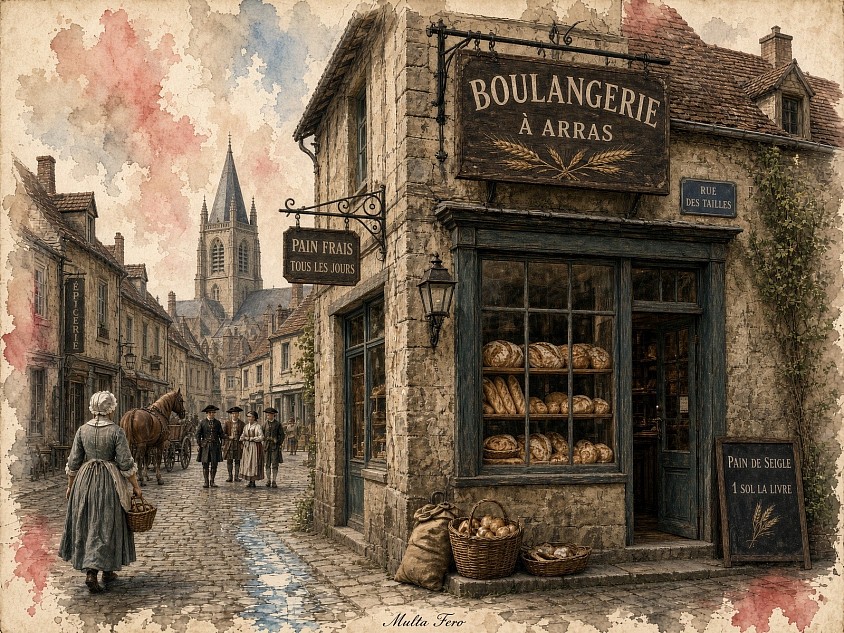
The year arrives first: 1775, a weather already chosen. Louis XVI is young and means well; meaning well, in a mortgaged garden, is perfume poured on a wound. Turgot bends over ledgers still paying for a lost Canada. Versailles dines; the pit fasts. Across the water Massachusetts fires at Lexington; a hill above Boston takes the name Bunker. Liberty is recast in a thinner metal. France hears it as a cracked wall hears thunder. In the East Pugachev is stamped into snow. Poland is divided. Bread is the nearer war. The Flour War has already taught women that an edict can empty a sack. Arras crouches under Vauban’s unused star. Sixteen years earlier another child of the same wet pavement has begun the apprenticeship of virtue. History is often two doors and one rain. On the twenty-third of July the sky of Artois does not leak; it strikes. At number 222 the painted lily holds. Above the shop Henriette labors since vespers. The midwife, a cousin who reads palms when the parish looks away, tells her to rob the air. Nicolas stays below with the oven, the true altar. Thunder is already in the room when the body arrives. The infant occupies the world: shoulders like first architecture, a chest that seizes air as a right. He does not petition; he protests. They name him Eugène-François. The cousin lifts the ridiculous palm and says only what the sky has said: stormy. The parish will write the twenty-fourth. The night writes the twenty-third. Dawn is vapor, not pardon. The boy grows as weather grows. Flour becomes climate. He learns fire’s moods before men’s. In the Place d’Armes he refuses the premise that he should be smaller than his body. Soldiers put a foil in his hand. The salle smells of sweat and badly kept steel. Two devout women prepare him for the host; he swallows as he swallows bread. Nicolas intends the oven for this second son. Eugène carries the basket and copies the till. Eggs betray him; spoons vanish into a pawnshop. The father pays for stone. The Baudets teach him that authority, even the authority that baked his bread, will borrow the state’s hand. Henriette fetches him home. He loves not being owned. That entry will not balance. The lily still promises a garden. The boy on the stair already knows he will not be planted. Most children arrive as questions. This one arrives as weather.
Chapter 2: The Fencing Master's Shadow
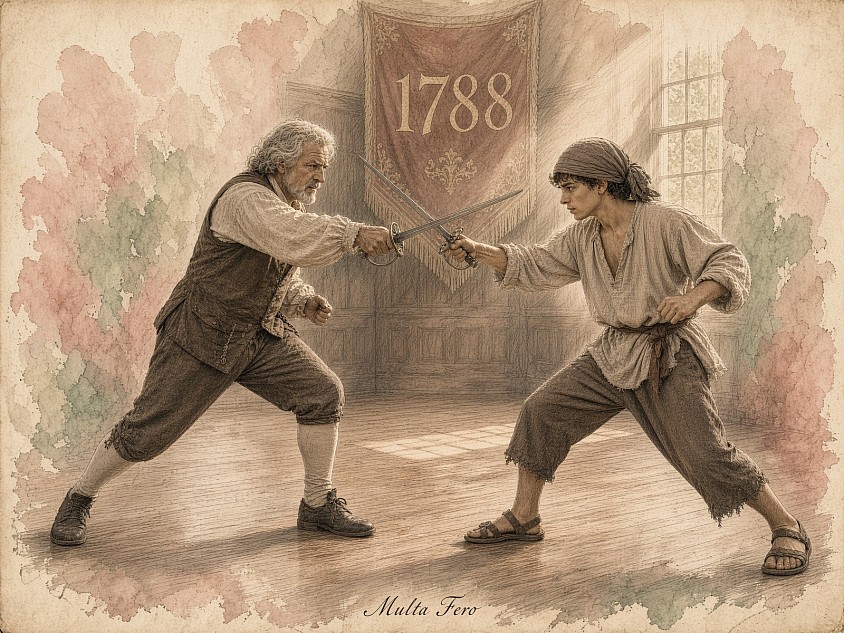
The year the roof thins is 1788. France still possesses a king; the sentence is no longer incense. Calonne falls, Brienne falls, Necker returns to a treasury that is an open mouth. Hail flattens the Île-de-France. Winter arrives as statute. Bread becomes a sentence. In May the Estates are dragged to Versailles. In June a tennis court is consecrated. In July a prison bleeds into allegory. Arras is not Paris. That is its shelter and its peril. It will send south another son of the same wet brick, already drilled in virtue. Such is the climate that shuts a boy’s thirteenth door. Eugène-François Vidocq already wears a man’s shoulders. The basket no longer suffices. Above a saddler’s shop Maître Anselme Gosselin, forgotten by his regiment, teaches that the hand is a liar and the point is not. The boy steals hours, then flour, then loaves from the hinder edge of the peel. He sells them in lower streets and to a woman who keeps swine. Gosselin takes the ugly coins and refuses to be chaplain of the oven. “I covet the wrist.” The notary’s son smells pedigree; the baker’s boy answers that baskets travel farther than doors. Arras keeps two nights. In the second he meets Hedon, Delcroix, Basserie, Lise of the two baskets. They name him Vautrin. A sergent collars him over warm bread; he leaves one loaf as signature. A brigadier of the maréchaussée names the lily and lets him go. To be spared is to be owned. Nicolas follows the stair, hears garde, lays strap beside receipts. Henriette puts the strap away. The boy takes a full measure of flour with a calm worse than haste and buys the hour reserved for the paying pupil. Gosselin chooses the shadow over the fee. Spring brings paper. Two officers wait on a baking day. The Baudets receives him: straw, a resigned saint, a bucket with opinions. On the tenth day the gaoler says the father paid for the stone. Henriette fetches him as the house, not as a wife. He goes straight to the loft. Gosselin names him the third kind: the pupil who learns the line so the world must follow him through the door. Their shadows part. The boy takes the citadel road with an empty basket. He lacks the word for what he is becoming. The age lacks it too. The lily holds. The garden does not yet know one of its fists has mastered the bind.
Chapter 3: The Broken Register
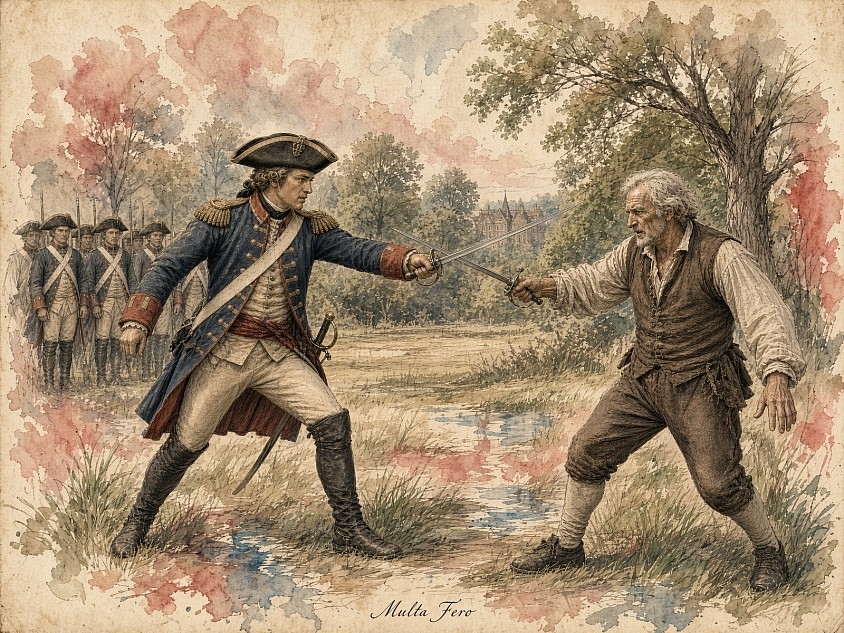
Spring, in a dying kingdom, is not weather. It is an argument that has learned to wear flowers.I am the gaze that arrives before ink consents to become a law. Do not yet ask of me the meadow. First take 1789. France summons her Estates. Three orders sit beneath a ceiling built to humble them. Vote by order, and privilege closes like a door. Vote by head, and arithmetic becomes revolution in a modest coat. Cahiers travel toward Versailles. Arras sends a thin lawyer of the same brick. Bread remains the other estate. Registers—parish, guild, prison, salle—wait to be believed. In Arras three modest tyrannies will not survive the day: the salle’s book of bouts, the bakery’s ledger of loaves, the book at the Baudets. Eugène is fourteen. The loft above the saddler has become his language. A lieutenant comes as a tourist of pride. The boy’s buttoned point finds the officer’s chest. The insult is small. Gosselin takes it as his own. Outside. Buttons off. First blood. In the meadow the rusted courtesy fails. The point remembers flesh. The master sits, not falls. He looks at the boy as at a phrase that must still be corrected. “Register.” A press upon the cuff. Then the head grows heavy. The lieutenant runs. Eugène runs a map of eyes, tears the unfinished page, hides pays in kind against his ribs. Nicolas buys two weeks of stone: bakery logic, a lily unspotted. Lime, psalm, purchased weather. They bury the master in hurried earth. They change the lock. The ovens stay open. Released, flour on the knuckles that held the wound, the boy extends an empty hand into dark. No forte. No foible. A name cannot be torn. He will write back—on water, if water will have him. Two futures walk the same brick and do not nod. Paper has learned it can bleed. I remain with the stain that outlives belief.
Chapter 4: The Stolen Silver
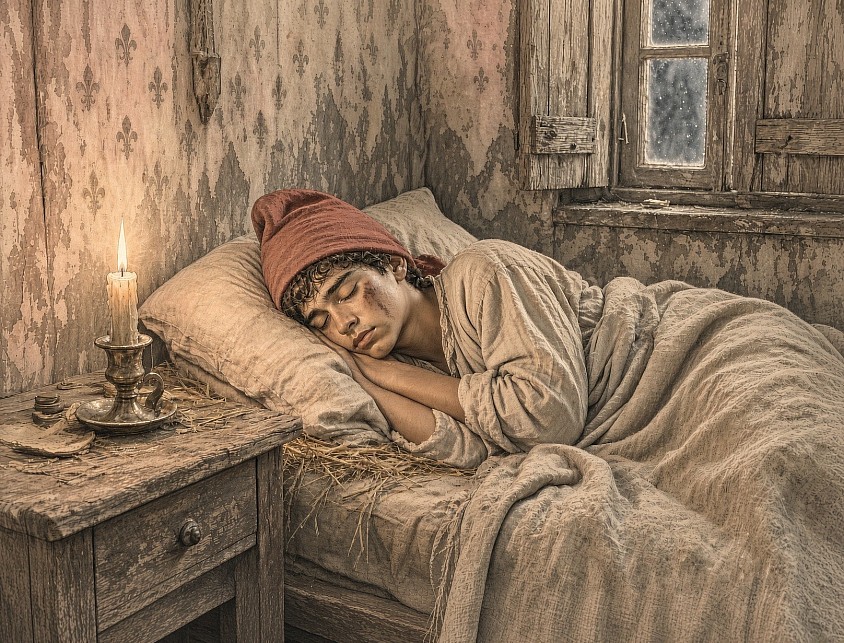
In 1791 the Eternal Observer stands where nations have begun to falsify their clocks. France chisels its calendar; the Bastille is sold by the stone; a king who still signs Louis has already been hauled back from Varennes as an exhibit. Across the Rhine the wells of chancelleries darken. The sea, which signs no constitution, slaps the piles of Dunkirk and Ostend as if politics were only weather. Two thousand francs is not a sum. It is a door. In the hour before the oven is fed, sixteen-year-old Eugène lifts the locked box on the rue du Miroir-de-Venise with a second key and a thief’s courtesy: he does not empty it. Cloth against his ribs, he walks north. America—unseen, therefore believed—is a forest without échevins. Henriette’s hand finds a cold pillow. Nicolas sleeps lightly over a key. The road thins. Lille watches. Flemish weather enters the inns. Dunkirk has no ship for Philadelphia; Calais has prices that would leave him naked. Ostend, under the Emperor’s flag, offers cheaper berths and hungrier captains. There Monsieur Blaise finds him first: jovial coat, open praise, a supper at Blankenberge that will not be charged. Laure’s questions map the cloth inside the shirt. Cards take what a scene would make dangerous; the rest waits upstairs. The bed is a lock that opens inward. He wakes to an empty shirt, a cart-track filling with sand, and a woman who knows no Blaise. He sells the coat. Hunger is punctual. A peddler named Godard offers the road and a share of nothing. Near Arras the boy refuses to sell elixirs before his mother’s door. He returns at dusk. Henriette signs the old treaty on his face. Nicolas leaves the strap hanging. “The army will take what I cannot keep.” The fourth register waits. The stolen silver has already become wine, a bed, a smile. The century empties larger boxes in Paris. The grammar of the emptying does not change.
Chapter 5: The Travelling Menagerie
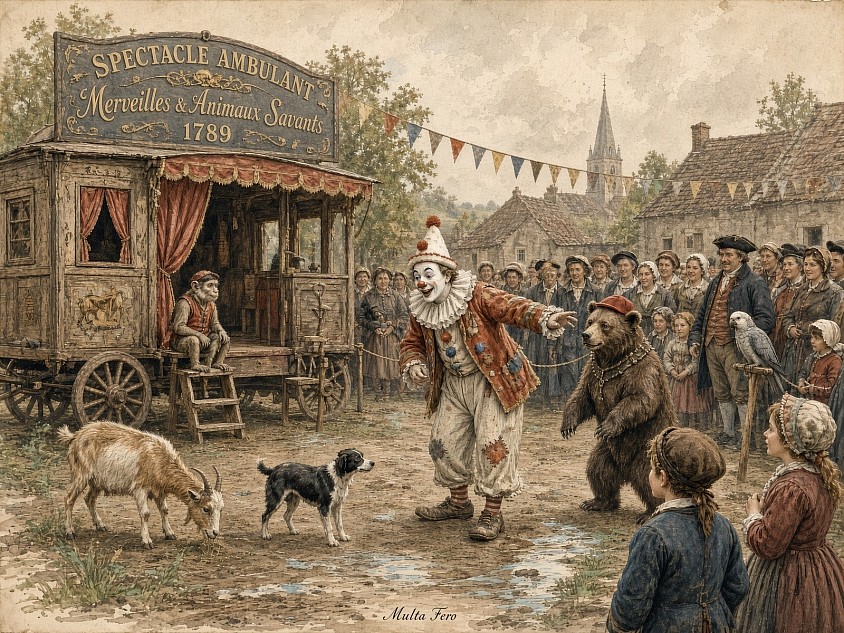
The year 1791 has begun to flee and has not yet learned that flight is only arrival. France stands with its furnace unlatched: a king hauled back from a night coach, the Champ de Mars already tasting blood called order, assignats quarreling with bread. North of that fever the Austrian Netherlands still wear the eagle. Into a Flemish square a country of canvas unfolds—same flags, different mud—and sixteen-year-old Eugène, coatless, the peddler’s pack refused, stands hungry at a painted board. Paillasse inventories the empty shirt and takes him to Comus, first physician of the world by coat and lie, and to Garnier, who prices nature as a cabinet. Occupation is lamps and monkeys. Beatings are bookkeeping. Balmate, the Little Devil, breaks him into tumbling until the boy says the word the company does not stock: enough. Then comes the costume of distance—a stiffened tiger pelt, a club, raw meat, flints that are only stained biscuit. He is to be a South Sea cannibal modeled on General Jacquot in cage number one. The square consumes not islands but Europe’s hunger in a foreign skin. Afterward he rinses a mouth that water cannot scour of benches. When the take is poor they order him into the cage to share a board with the ape. He says no. He breaks the stick. He tears the pelt off in a ditch among reeds and gives pursuers the drunkard’s leap that, for once, is a door and not a product. He steals a shirt from a hedge, names himself baker to a patrol, washes the act in a cow trough, and turns toward a lily and an oven. The menagerie folds and rolls. The baker’s son becomes a road again. A no at the right iron, the Observer notes, is worth more than a sixteenth of profits never meant to be paid.