
Act II: Blood and Powder (1791–1795)
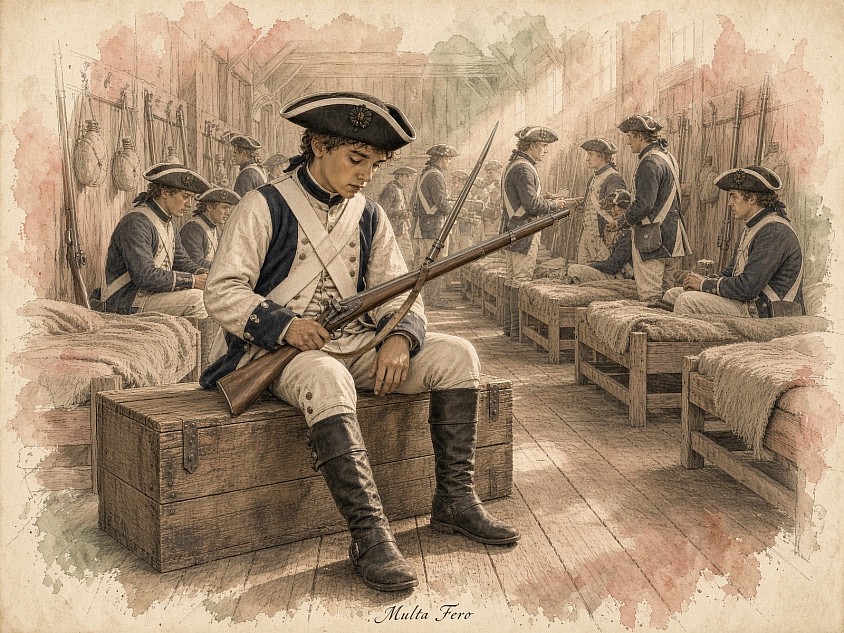
Chapter 6: The Bourbon Regiment
Ink, in the spring of 1791, still names a king and already names a nation, and both dry on the same damp page. On the tenth of March, Eugène-François Vidocq sets his name in the register of the Régiment de Bourbon, quartered beneath Vauban’s idle star at Arras. The parish would deny him sixteen. The tape does not. A white coat, christened once in a trough, closes over baker’s linen and a thief’s salt. Henriette waits beyond the threshold, hands buried so the town will not inventory their tremor. Nicolas does not come. A father who offered the army as stock cannot always watch the stock receipted. The oath is a short rag—king, nation, discipline—and the knots already crawl. He recites them as he once recited catechism. A musket is offered with the piety other men keep for relics. He lifts it. For the first time since the menagerie he is a stroke among strokes. The citadel accepts new cloth as it accepts all cloth: wet masonry, beans too long beans, a drill that treats the body as a weapon still ignorant of its nature. On the third evening a corporal names an empty till. Eugène names an hour. Beyond the glacis, first blood. By June—Varennes accomplished, the king returned like a parcel—the yard has a word. Téméraire. Reckless. The list ripens by repetition. Fifteen affairs. Two sittings. July heat. A sergeant who will not stoop to a foil wants rank to remain altitude. Habit overreaches. The edge finds the neck. A dead sergeant is paper, and paper climbs; the captain throws custom over the stain. August. A volunteer loud with nation takes offense at Bourbon on the cloth. The point passes deeper than books had promised. He dies at noon asking for a mother. Prefer the drill, the captain says. The corps can afford the wrist. It cannot afford the obituaries. A week. Then thirteen, fourteen, fifteen. Fourteen days of bolt teach the length of a breath. A watch blinks. A body is absent at morning count. Reckless remains—the price of remaining useful to a tale. On the twentieth of April, 1792, France declares what the roads have declared for a year. Arras plants a liberty tree. Henriette puts better bread in the pack and touches the collar as if it were still a shirt she could wash. Do not sit anyone else down if you can stand them up. Nicolas, from the square, does not lift a hand. The column takes the road once used for bread and flight. The lily recedes. The two dead do not. The next page will not be a strip beyond the glacis. It will be a field that does not traffic in first blood.
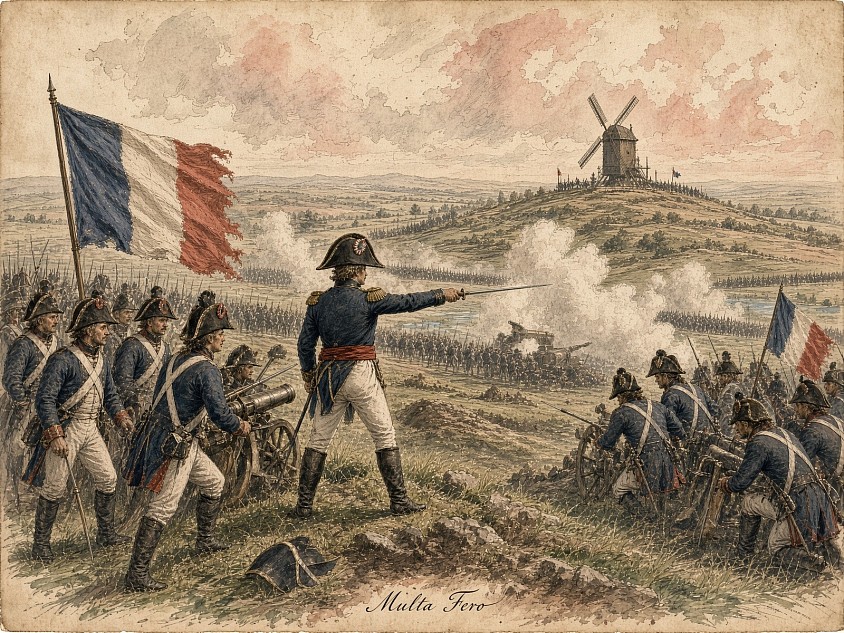
Chapter 7: Valmy and Victory
Fog has already chosen the hour; I only keep the pen. In that September, France, having unmade a palace, must learn whether a people can still make a country. On the tenth of August the Tuileries becomes a verdict. The Swiss fall. The king becomes a prisoner in all but the last syllable. Brunswick’s manifesto promises Paris a vengeance like scripture written by a quartermaster. Paris answers with prison massacres. Priests, Swiss remnants, debtors, and the unlucky are hauled into courtyards where the law has gone on holiday. Longwy opens. Verdun opens. Champagne is a soaked plate. Dysentery outruns dispatches. Shoes dissolve. Manifestos do not. On the twentieth, fog is a third army. It takes no side and both. Eugène stands in it at seventeen: a patched coat once Bourbon white, now the color of roads, a file on a ridge crowned by a mill. Valmy was a village yesterday. Today it is a sentence Europe must read twice. Kellermann holds the ground. Brunswick turns in the white like a key. The Prussian line appears as a proverb. Then the French guns speak, and the proverb must walk in mud. Soft ground drinks the ricochet. What does not die is the noise. Toward afternoon a Prussian shell finds three powder wagons near the stump of the mill. A second sun lifts. The line flickers toward a crowd. Eugène takes a cartridge box that has survived the scorch and brings the teeth back. The sergeant files both boy and box. Kellermann sets a hat on a sabre. “Vive la Nation!” travels. Eugène puts the word in his mouth because the alternative is the gap. The Prussians come to six hundred yards and halt. By four, Brunswick, who can count mud, flux, and a ridge that will not run, calls it off. Victory here has no heaps. Three hundred French, perhaps; fewer Prussians. What dies is a certainty: that a revolutionary file will open if a proverb walks toward it. Paris remains Paris. The mill remains a stump. On the twenty-first the Convention stands up as a republic. In November, in a yard that is not Valmy, the baker who did not enlarge the gap receives a grenadier’s stripe and the name corporal. A man three files down polishes a bayonet on the same cloth and watches the stripe as if it were already his to tear. Valmy is a refusal, not a heap. He stood. The coat is not finished with him.
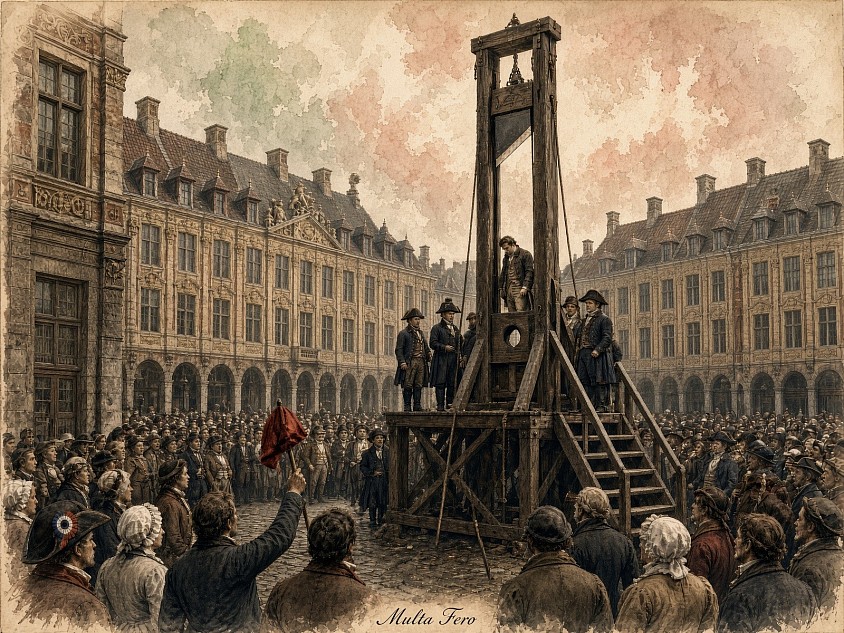
Chapter 8: The Guillotine at Arras
Year II does not knock. It is already seated in Arras, keeping its books in blood and decree, while the Eternal Observer stands inside the months that made suspicion a trade. The king is cancelled; the queen has followed him to a plank. The Committee does not sleep. The Law of Suspects has turned the neighbor into a clerk of the last hour. The Vendée burns; Lyon has been chastised; Toulon has been retaken by a gunner not yet a continent. Grain is a decree. The Maximum is a creed. Too much bread is hoarding; too little is conspiracy. Terror is not a temperature of the soul. It is a ministry, and it has sent Arras its own son. Eugène Vidocq returns at eighteen under a sky the color of unused iron: corporal’s stripe folded into a bundle, Bourbon coat gone, deserter’s knowledge ticking in the wrist. Jemappes he tells badly. Dumouriez has soured. The lily over the bakery has been painted out. Henriette draws him in before he knocks. Nicolas, thinner and civic, looks at the bundle as at a fuse. “Writing is cheaper than powder.” She sets bread before him as if bread were still only bread. Joseph Le Bon, Oratorian become représentant en mission, has taught the Petite Place a new drama. The boards are not painted. They are red. An orchestra fills what speech may no longer say. Official death has a carpenter and a cheerful key. Eugène sees de Mongon, once commandant of the citadel, ended as a program. Henriette tells him not to go again. He goes. At the fish market a finger finds the last decent cloth under a borrowed shawl. Claire de Vieux-Pont does not run. Eugène steps between the hand and the cloth and calls her cousin, a lie the size of a till. The promise left behind is enough. Le Bon hears without having been there. In a clean room he smiles, names the parish name, and asks for the mother. Henriette goes and comes back smaller. Usefulness stands until it casts the wrong shadow. Claire is called. Eugène is in the crowd and does not reach the boards; reaching would write a second lie. The instrument shouts. The program does not pause for shawls. The message to a mother stays in his pocket. Her door takes a seal; the knocker is taken for metal. A parrot may be learning a new cry. Chevalier’s sister is offered as a gentler nail, a passport that laughs. He does not love her. He leaves before the lists remember François too clearly. Henriette touches the bundle. “If you find a mother on the road, give her the sentence. It does not matter whose.” He walks south between two clocks: the trough that still rises in the dark, and the boards that keep the nation’s hour. Frost cracks under a deserter’s boot. A patrol’s lantern crosses him and does not stop. He carries a lie the size of a till and a silence the size of a shawl.
Chapter 9: The Chasseurs Royale
Between the last syllable of a cannon and the first of a scaffold, a baker’s wrist learns that a victory can be locked from outside. On the first of November, in a yard still damp with Champagne, Eugène-François Vidocq is made corporal of grenadiers. The bearskin makes him taller than his history. A sergeant-major, owner of more winters than Valmy, looks at him as a loft once looked: height not earned in the proper rooms. Words follow—bakers, tills, painted savages. Eugène names a place, an hour, a blade. The man refuses to duel bakers; he files them. Eugène hits him. Blood does the rest of the talking. Striking a superior is paper, and paper climbs toward a court. He does not wait for the ink. With a companion whose ear is incomplete since the mill, he unpicks the stripe in the dark and walks. A sentry who prefers a boy who closed a gap to a nose that opened a file looks at the stars. They enter the 11th Chasseurs under a name almost his and a parish not quite Arras. Shoulders are the passport. By the sixth of November the green is walking toward Jemappes. Dumouriez moves as if Belgium were a theorem already proved. Eugène kicks a door, guards a well, does not take the silver. The companion takes a clock and is made to put it back. Night inventories four coats. He files the wish to remain a gap that walks. Winter eats the victory. Belgium is a rented room; requisition looks like liberation until the cellar is empty. In January the camps hear that the king has sat down in Paris. Some cheer, some kneel, some spit. England, Spain, and Holland hear a bell. The Coalition thickens into a ring. Eugène toasts the road and does not walk yet. Spring tastes of defeat before leaves. Neerwinden throws Dumouriez; volunteers melt. Then the fact: the victor has been writing to Austrians, and on the fifth of April rides into an Imperial camp. In a barn become an office a clerk says the baker’s name—grenadiers, struck a superior, now green. The companion stays in straw-shadow. Eugène chooses the darker door. A ditch, a bad password, hands up. He gives more truth than he gave the 11th. An Austrian captain offers a cockade that is not theirs. He takes it because the pen is the alternative. They call the formation what the bills need: Chasseurs of the King. A greener green. Gentlemen with particles look at Picard bakers as material. Facing France, he does not fire on a file that might hold a childhood. Not firing is marked in a quieter book. A lieutenant younger in years and older in particle wants grief as property. Eugène puts the duel down. Putting it down is the most expensive thing he has done since he refused a court. A captain under a white rag offers a way back for a man who never fired on his own. At first light a French voice asks a question with two answers. He chooses the one that is not a volley and speaks a word almost a rank so the late companion is not shot. He is not welcome long. Beside a wagon, without drum or speech, he is told the army has had its fill. He walks—eighteen, or nearly—toward Arras, carrying two muds and five coats, none of them a skin. Living is the only drill he has not yet been ordered to forget.
Chapter 10: Double Agent
1793 asks a password before it asks a hill, and a baker’s son learns to answer with a coat. Still in the Emperor’s cloth, enrolled with Kinski’s cuirassiers, Eugène wears iron where a stripe once sat for less than a day. The companion has peeled toward a village. What he fears is not the Austrian word for forward but the morning he must cross swords with a file that still owns a piece of his shout. He arranges a fever. Sweat can be washed; shouts cannot. At Louvain he studies the honest sick and underplays. A surgeon calls the pulse theatrical. Eugène calls it French and is given another day of vinegar. A woman with a lamp tells him not to teach the ward his craft. When he can stand, the garrison, bored since the last patrol, requisitions a dining room. He disarms men who paid for the title of master. Florins follow. A portrait faces the wall. For a week a salle almost feels like a country that does not care which hymn was shouted on a ridge. Then he is too pleased with a brisk attack on a visiting brigadier. The blade leaves the hand with the sound of a stick broken in a fair. Twenty stripes of the cat, on the square, to a drummer’s clean count. Official pain has music; domestic pain had only a belt. He looks at a chimney so the chimney will be what he remembers. He takes the next lesson because the body still prefers florins to a second signature, and because the decision to leave is already seated. He rides as a lieutenant’s servant toward Schroeder and takes French leave near the pickets, leaving the horse and the cloth under leaves. A farm wife gives him milk and wants no story. At Landrecies he offers a Flemish hitch learned in Ostend alleys and the claim that the banner flogged him. They want cavalry; he chooses the 14th light, where a face can smear. A new roll takes a name that is not Vidocq. Posts become rooms. He is a wounded aide, a commissary’s cousin with oats, then only large. In a market he buys a coat that once gave orders. A gendarme who knows a baker’s width is defeated by stew and a white sock on an invented horse. Under a hedge he tests syllables and keeps Vidocq in the pocket like a last louis. He faces either hill and owns neither. The cat remains written. The hitch remains borrowed. France receives him as weather receives a coat: by letting it pass without learning its name.
Chapter 11: The Marriage Trap
Thermidor unbuttons a prophet in Paris and, eight days later, buttons a baker’s son in Arras. He is in Lille in the last heat of Year II: nineteen, the Belgian hitch wearing thin, the cat’s writing faded, selling the foil and a little clerking above courtyards. Patriot Chevalier finds him because men who know Joseph Le Bon collect useful problems. The sister is Marie-Anne Louise, older by enough years to have learned patience, close enough to a proconsul’s friend to make a denunciation into a domestic errand. Suppers follow. She pours and does not spill. The brother speaks of households as quieter than roads, and of roads as a confession to whoever still keeps lists. One afternoon, when the canal smells of heat, she says she is carrying what he put there. The sentence sits on the table like a second cat. He does the arithmetic. A child would be a roll he cannot desert. A brother who can speak to Le Bon would write deserter while Paris, far off, learns a new night. Arras has not yet eaten its own weather. He walks until only bakers and thieves are honest, then goes home for consent. Henriette does not ask if he loves the woman. Love is not the currency of this month. She gives the consent mothers give when the alternative is a kitchen that is not a bakery. Nicolas signs because a married deserter is a quieter object. On the twenty-first of Thermidor, before an officer of the civil state, they swear. No priest. A fly walks the inkwell. For a few days he almost believes he is a father. Then she tells him the truth as if it were a wedding gift delayed. There is no child. There was no story except the plan, and the plan worked. He keeps his counsel. The brother still writes. He will not give Le Bon a sentence of his own. They open a mercer’s shop. It fails. She is at her brother’s; he drinks and disappears. An adjutant’s laugh gathers at the table like climate, not yet proof. On the quays a drinker already knows the Arras baker who married Chevalier’s sister. Names that travel are lists that have learned to walk. He inventories seven coats. The seventh is paper, and paper is what the year does best even as it begins to die. He takes money from the till and calls it wages for a year he did not choose. She does not use the cry that holds men. He puts the coat on. That is the trap’s last cleverness: it does not need to chase. It has already been put on. He walks toward any town that will not yet ask to see a marriage line.
Chapter 12: A Fatal Forgery
After the scaffold is put away, the Directory governs by letterhead, and a fist on a stair becomes the preface of a longer sentence. In Lille, Eugène finds Pierre Laurent Vallain half-dressed on the landing: adjutant, welcome at the brother’s table, owner of a laugh that has been filed for weeks. They do not fence. Rank on a stair is only cloth. The blow is an assault, and an officer can translate an assault into paper. Louise, practical even in smoke, weighs which man still opens doors. Vallain descends with blood in his mouth and a future deposition in each step. A neighbor’s ear is already a witness. By morning there is a complaint in a hand that knows how officers write. Three months, the judges say, clement because he has been a soldier. They give him a chamber of his own in the Tour Saint-Pierre and call it the Bull’s-eye. The window watches Lille as a wound watches a surgeon. Francine brings soup and does not inventory wives. The other hours he spends among longer sentences: Grouard and Herbaux, forgers who once counterfeited stewards and now counterfeit the nation; Sébastien Boitel, six years for garden tools that a court made into an article, father of too many, weeping over a farm that will not plough itself. They ask, politely, to use the quiet table. A mémoire, a letter to cassation. He nods and goes down to the yard. He comes back to warm wood and the smell of oak gall. Hosts do not inspect guests’ pockets. The night before Boitel is to walk they eat almost-meat and examine a seal as hungry men examine bread. Boitel leaves without adieux. Then the inspector who can read letterheads arrives. The pardon is a phantom. Questioned, Boitel remembers four hundred francs and the man who owned the quiet room. Ownership, in Year IV, is complicity. When the three months end, the door does not. Francine brings an officer’s coat in a muff; a sergeant knows the baker’s width, and he walks back because judges like a return. Judges like a file. She will not bring another muff. Love near a tower is a deposition. On 7 Nivôse, Year V, Douai reads the article: forgery of a public and authentic paper, eight years at the galleys. He lent quiet. The court calls quiet a workshop. He does not appeal. The chain to Bicêtre is already a rumor with boots. He studies exits instead—loose stones, bolts, the hours until the guard changes—and intends, as he has intended since a meadow chose neither army, to be elsewhere when the boots arrive.